
Why Damage Keeps Repeating in Cold Storage Facilities
Cold storage facilities are designed for efficiency, not impact recovery. Tight aisles, freezer transitions, and nonstop vehicle movement mean the same doors, rack ends, and walls are struck again and again. Over time, those repeated impacts turn routine operations into ongoing repairs, downtime, and long-term structural wear.
Where Industrial Damage Adds Up

Racking & Rack Ends
Ongoing forklift strikes deform racking over time, increasing repair work, product loss risk, and operational downtime

Freezer Doors & Access Points
Repeated vehicle contact damages door frames, seals, and surrounding structure, leading to frequent repairs and access disruptions.

Floors and Fixings
Protection that transfers impact force into the floor can accelerate concrete damage, anchor failure, and costly floor repairs.

Labor & Downtime
Maintenance teams spend time fixing the same areas repeatedly, pulling resources away from operations and increasing total downtime.
Damage Doesn't Stop at the Point of Impact

The compounding cost of repeated impacts
In cold storage environments, impacts rarely affect only the point of impact. When for is transferred instead of absorbed, damage spreads into floors, fixings, and surrounding infrastructure. Over time, repeated strikes increase repairs, maintenance demands, and downtime that skyrocket long-term costs.
Steel Transfers Impact. Polymer Absorbs It.
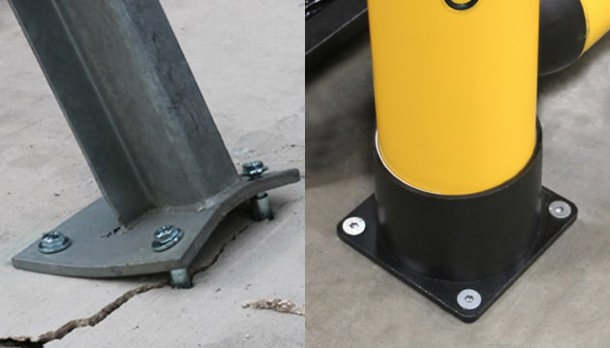
STEEL BARRIERS
-
Rigid structure with no built-in mechanism to manage impact energy
-
Transfers force directly through the barrier into anchors, concrete, and surrounding structure
-
Permanently deforms on impact, increasing stress on fixings and floors
-
Requires repair or replacement after repeated strikes
POLYMER BARRIERS
-
Engineered to flex and deform on impact, dispersing energy through the system
-
Reduces peak force at the point of contact before returning to shape
-
Limits energy transfer into floors, fixings, and adjacent infrastructure
-
Designed to perform after repeated impacts without structural failure
The Original Polymer Safety Barrier

Designed to Solve the Problem Steel Couldn’t
Traditional steel barriers were never designed to manage repeated industrial impacts. They were adapted from other uses, not engineered for the realities of high-traffic facilities.
A-SAFE became the pioneer of industrial safety by designing impact protection around energy absorption rather than force transfer. Polymer barriers were purpose-built to perform after impact, reduce repair intervention, and support more predictable operations in environments like cold storage.
Popular Products

Designed for sub-zero environments. High-strength guardrail with handrail. Protects people and assets from heavyweight vehicles.

Designed for sub-zero environments. Multi-purpose impact protection for corners, doorframes, loading bays and vital assets.

Designed for sub-zero environments. High-strength guardrail for segregating heavy vehicles. Protects assets from impact damage.

This helps connect you with an A-SAFE specialist to review your cold storage environment and share relevant information. A team member may follow up to learn more about your site.