By DAVE DALLESKE | Senior Vice President of Sales, U.S. | A-SAFE, Inc.
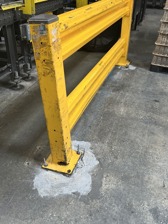
Have you seen something like this lately? I took this photo at a site I visited this past year. Yes, the guardrail has presumably done its job by protecting the aisle behind it. However, did you notice the old anchor holes in the floor where the barrier was initially installed? Or that the concrete floor has been repaired yet again on both sides, weakening the substrate? Lastly, what about the trip hazards from the raised anchor bolts on the base plate? Arguably, if this guardrail takes another significant impact, then the entire concrete floor in this area may need to be replaced due to stress fractures and the inability to reinstall another guardrail in its place.
This is the conversation I find myself having more frequently nowadays. It's not about which brand of barrier to buy, but about whether the barrier is even suited to address the problem facilities are trying to solve. Steel was the obvious answer for decades, and in many structural applications, it remains the right one. But for dynamic impact protection in busy industrial environments, the physics of steel works against you in ways that the industry has been slow to accept.
The Energy Problem Nobody Talks About
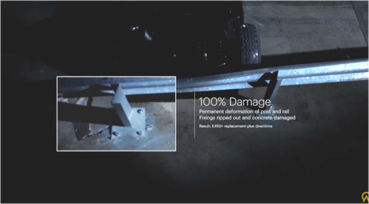
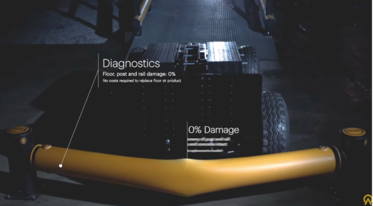
To prove my point, we ran a trial test of steel versus polymer barriers and reviewed the results.
When a forklift hit the steel barrier, the barrier performed just as we would expect. Once impacted, it deformed and the concrete floor beneath it cracked as the force must go somewhere, and the laws of physics are not negotiable there. Energy that isn't absorbed by the barrier itself transfers into the anchors, into the floor, into the racking behind it, and into whatever the barrier was meant to protect. This isn't a design flaw in any particular product but is a fundamental outcome of rigid materials under a dynamic load.
The Copycat Problem Is Real, and It Has Consequences
A-SAFE invented this category. I say that not as a marketing line but as a statement of fact. We developed the first engineered polymer safety barrier in the early 2000s, put it through independent laboratory testing, built the installation methodology from scratch, and spent years convincing an industry that had always used steel that there was a better answer. That history matters because it explains what happened next.
Once the category existed and the market started to validate it, other manufacturers moved in. Some of them did the engineering work; however, many of them did not. They copied the shape, the color scheme, the product names, even placed our product images on their website, and then filled them with whatever polymer compound was cheapest to manufacture that week. The result is a market where genuinely tested, certified composite barriers compete on price next to products that will not perform to the same standard under real-world conditions.
I have seen what happens when a safety product fails the one test that matters when someone is tired and misjudges a corner. The cost of that failure is not measured in replacement barrier sections but is measured in things that cannot be replaced. So, when I talk about the importance of engineering validation, third-party certification, and documented test protocols, I am not trying to win a spec argument. I am trying to make the case that the specification process itself needs to ask harder questions about what is inside the product.
"Plastic" Is the Wrong Word
I understand initial skepticism and hesitancy to make a change. When A-SAFE first started selling engineered polymer barriers into the market 20+ years ago, the pushback we heard most often was "You want me to replace my steel guardrail with plastic?" I get it; the word "plastic" carries negative connotations of fragility and disposable packaging. It is not a word that inspires confidence in a safety-critical application.
But the material we are talking about is not plastic in any meaningful sense of that word. Advanced polymer composites are engineered at the chemical and molecular level to specific mechanical performance requirements. Amongst them, we test impact resistance, energy return, temperature stability, and UV durability. It's the same family of materials that are used in aerospace components, medical devices, and high-performance automotive parts.



More importantly, many of the polymer barriers on the market today are not engineered at all. Instead, they are extruded from the commodity resins and shaped into what looks like safety products without having been designed to perform as safety products. This is a real problem in our category, and one I think deserves more scrutiny than it gets. The gap between a commodity polymer barrier and a purpose-engineered composite is significant. It is a matter of whether the product will do what it says on the label when a three-ton counterbalance truck hits it.
What a Modern Specification Should Actually Look Like
If I were advising a safety team to put together a barrier specification today, I would start by asking them to separate the performance requirement from the material assumption. The question is not "steel or polymer". Instead, the questions are, "What impact energy does this location need to manage?" "What is the amount of risk I can accept?", and "What does the total cost of ownership look like over five years, including maintenance, replacement, and any incidental damage to protected assets"?
When you frame it that way, the answer is often not the same answer that appears in the initial capex comparison. Steel barriers may appear less expensive on the purchase order; however, they frequently look considerably more expensive when you add up the floor repair, the racking realignment, the replacement costs, and the operational disruption, all of which are real costs that somebody in the organization is absorbing even when they don't appear in the safety budget.
Then I would ask them to require third-party validation data, not manufacturer testing, not sales literature, but documented independent test results that show how the product performs at specified impact speeds, weights, and angles. ANSI MH31.2 is the relevant standard in North America, and it exists for exactly this reason. If a supplier cannot produce those results, that is a discussion worth having before you install their product in your facility.
The Shift That Is Already Happening
The good news is that the industry has changed significantly over the past few years. When I do a safety assessment at a facility with an EHS director today, I am much less likely to debate the basic case for engineered polymer solutions. The performance data has had time to accumulate, the installations have been in the field long enough to demonstrate what the long-term cost profile looks like, and the regulatory environment has pushed organizations to be more rigorous about how they document their impact protection decisions.
What I still find myself pushing back against is the idea that all polymer barriers are the same, or that the category is mature enough that the engineering details no longer matter. Instead, they matter enormously. The difference between a product built on 20+ years of engineering & research versus a commodity extrusion that happens to be yellow is not visible in a product photograph, and it is not legible in a price comparison. On the contrary, the difference appears in a controlled laboratory test, and it appears with far more serious consequences in the field.
Steel served the industry well for a long time, and I have no interest in dismissing that. However, facilities being built and retrofitted today are operating at velocities and traffic densities that were not common twenty years ago, and the case for material science that was purpose-built for that environment has never been stronger. The question is whether the specification process catches up to what the physics has been telling us all along.