


Barrier specification is often treated as a late-stage decision in industrial projects. Floor plans are finalized, racking layouts are set, coordination is largely complete, and barrier systems are added as a final step to satisfy OSHA 1910.176 material handling standard requirements.
At that point, the decision appears straightforward. A steel guardrail is specified, installed, and the project moves forward.
What is rarely considered is how that decision affects the building's performance.
Not long after operations begin, familiar issues appear. Barriers are bent, anchor bolts loosen, and concrete flatwork begins to crack around fixing points. Maintenance teams return to the same locations repeatedly to patch and repair. These outcomes are often treated as operational wear.
They are not.
They are the result of how the specified system handles impact energy.
The critical question is not whether a barrier stops a vehicle. It is what happens to the energy after impact.
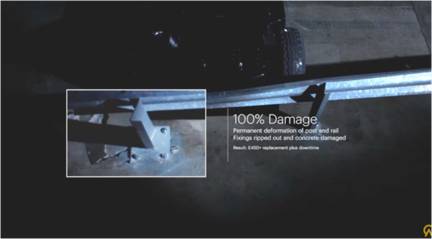
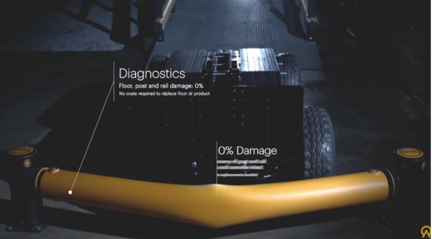
Barriers Are a Design Decision, Not a Late Add-On
Barrier systems should be specified during the design phase, alongside decisions about slab-on-grade layout, traffic flow, and structural coordination.
This is not a matter of complexity. The necessary information already exists within early drawings.
Warehouse traffic management plans clearly show where forklifts will travel, where turning movements will concentrate, and where pedestrians and vehicles will interact. These are the areas that will experience the highest frequency of impact.
When barrier placement is deferred, coordination issues follow.
Anchors are installed too close to control joints or expansion joints, where the concrete is already designed to accommodate movement. Adjustments are made in the field. Fixings are relocated. Concrete is cored or patched before the facility is fully operational. The industrial floor system is compromised before it is even placed under load.
Barrier selection is not a finishing detail. It directly influences structural performance and long-term durability.
How Impact Energy Moves Through Rigid Systems
A forklift impact is a dynamic load event. A forklift impact is a dynamic load event that creates concentrated force at the point of contact.
In a rigid steel barrier system, that force is not absorbed. It is transferred.
The load path is direct:
through the barrier → into the baseplate → into the anchors → into the concrete slab.
The barrier deforms. The anchors are stressed. The surrounding concrete flatwork begins to fracture.
This behavior is not a product defect. It is a predictable outcome of rigid materials under dynamic loading. Steel is effective in static structural applications, but in impact protection scenarios, it transfers energy into the structure it is attached to.
Anchor embedment depth and fixing design influence performance, but they do not change the fundamental behavior.
If the system does not absorb energy, the slab will.
The Hidden Failure Point: Anchors and Slab
Visible damage is often limited to bent rails or shifted posts. The more significant issue develops below the surface.
Repeated lateral loading degrades the anchor interface with the concrete. Micro-cracking forms around the fixing points and propagates outward. Over time, this reduces the effectiveness of the anchor and weakens the surrounding slab.
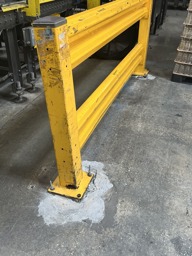
This damage is most severe in predictable locations:
- areas adjacent to control joints
- regions near expansion joints
- high-traffic aisles and turning zones
These are already the most vulnerable parts of a slab-on-grade system. Concentrating repeated impact forces in these locations accelerates deterioration.
The barrier is not the first component to fail. The floor system is.
This Is a Predictable Design Issue
Impact damage in industrial facilities is often treated as random or unavoidable.
It is neither.
Traffic patterns are established during the design phase. High-risk zones are clearly visible in layout drawings before construction begins. The frequency and location of impacts can be anticipated with a high degree of accuracy.
When damage occurs repeatedly in the same areas, it is not an operational anomaly. It is a direct result of how the facility was designed.
Barrier systems that transfer energy into the slab will produce consistent, repeatable damage in those zones. Repair cycles, anchor replacements, and localized floor failures are the expected outcomes.
This is not a maintenance issue. It is a design decision.
Engineering for Energy Management: A Different Approach
Traditional barrier systems are designed to resist impact. The structure remains rigid, and the resulting force is transferred into the floor system.
A-SAFE systems are designed to manage impact energy within the barrier itself.
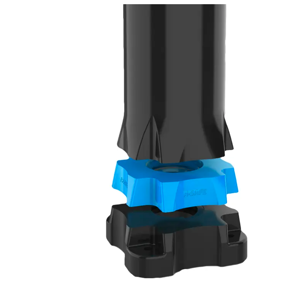
A-SAFE barriers are engineered using a three-layer design, where each layer performs a specific function during impact:
- Impact Zone
- The outer layer absorbs the initial force of contact, reducing peak load at the point of impact.
- Shock Absorption Zone
- Energy is dispersed throughout the barrier structure, limiting the amount of force transferred beyond the system.
- Stability Zone
- The internal structure maintains alignment and integrity, allowing the barrier to recover and perform after repeated impacts.
This approach changes how forces interact with the building.
Instead of driving energy into anchors and concrete, the system absorbs and dissipates energy before it reaches the slab.
The result is reduced stress on anchor fixings, preservation of slab integrity, and fewer repair cycles in high-impact areas.
The Question That Should be Asked at the Design Stage
Barrier selection determines whether impact energy is absorbed by the system or driven into the structure.
That decision is made during design, not after installation.
If impact energy reaches the slab, the consequences are already set in motion:
- Progressive damage to concrete flatwork
- Reduced anchor performance
- Repeated repairs in critical traffic areas
- Shortened lifecycle of both barrier systems and floor infrastructure
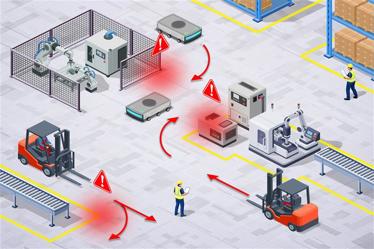
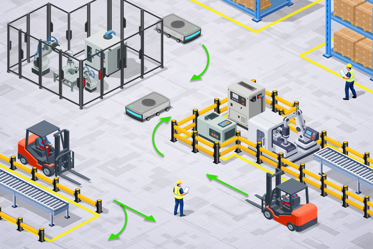
Designing for long-term performance requires evaluating how protection systems interact with the building, not just whether they meet minimum safety requirements.
The question is not whether impacts will occur.
The question is where the energy will go when they do.
Access Resources:
Barrier systems should be considered during the design phase, not after construction begins.
To support this, we provide:
- BIM & Specification Resources
- CAD and BIM files to support early-stage planning and coordination
- Performance & Testing Data
- Verified impact performance and classification data for specification
- Installation Guidance
- System requirements and best practices for correct implementation
Download these resources here: