Initial Investment
The protection system, installation and initial project cost.

Total Cost Of Ownership
The upfront quote is easy to compare. The costs created after installation are harder to see. Maintenance, replacement, floor repairs, secondary damage and downtime all contribute to what impact protection actually costs over its lifetime.
The protection system, installation and initial project cost.
Inspection, repainting, corrosion treatment and ongoing remediation.
Damaged barriers, components, labor and reinstallation after impact.
Concrete and mounting-point repairs caused when impact force reaches the floor.
Vehicles, racking, machinery and infrastructure affected beyond the barrier itself.
Restricted access, maintenance work and interrupted operations while damage is repaired.
Risk & ROI Calculator
Use the A-SAFE Risk & ROI Calculator to estimate exposure, explore the financial impact of damage and downtime, and build a clearer business case for prevention.
Estimate risk exposure, downtime impact and potential ROI using your facility inputs.
The Hidden Cost Of Impact
A collision does not always end with a damaged barrier. The financial effect can spread into the floor, surrounding assets, maintenance workload and normal facility operations.
The initial strike starts the cost chain.
What happens next depends on how the protection manages impact energy.
Repair, replacement, parts and labor.
Concrete repairs and mounting-point remediation.
Vehicles, racking, machinery or infrastructure can become part of the bill.
Repairs, labor and operational disruption continue beyond the initial impact.
The barrier is only one part of the repair bill.
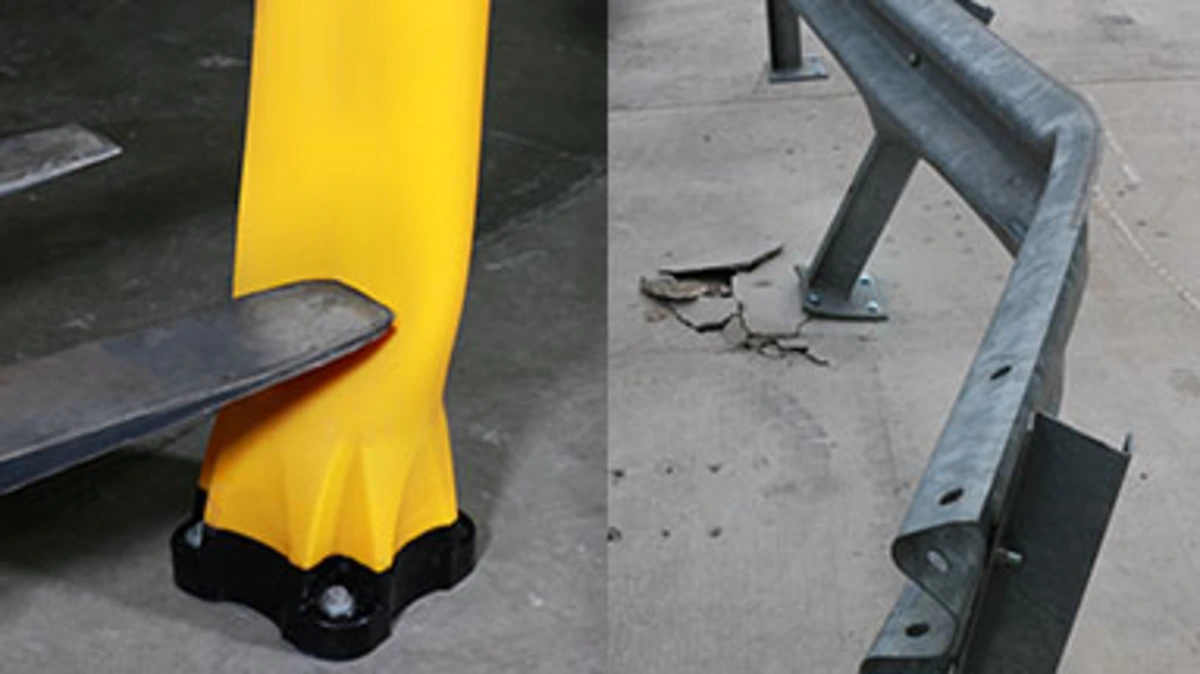
Traditional Steel
The initial price is only the beginning. When impact creates permanent deformation, floor damage or another maintenance event, the same protection point can continue generating cost.
Rigid steel can bend or buckle after a significant impact, creating another repair or replacement event.
Force transferred through rigid posts and anchors can create additional concrete and mounting-point damage.
Removal, replacement parts, installation labor and floor remediation can all add to the cost of one strike.
Paint damage, corrosion and visible deterioration add recurring maintenance requirements over time.
Engineered Polymer
Lower lifetime cost begins with impact behavior. A-SAFE systems are engineered to manage energy, recover after impact and reduce the secondary damage that turns a collision into a larger repair event.
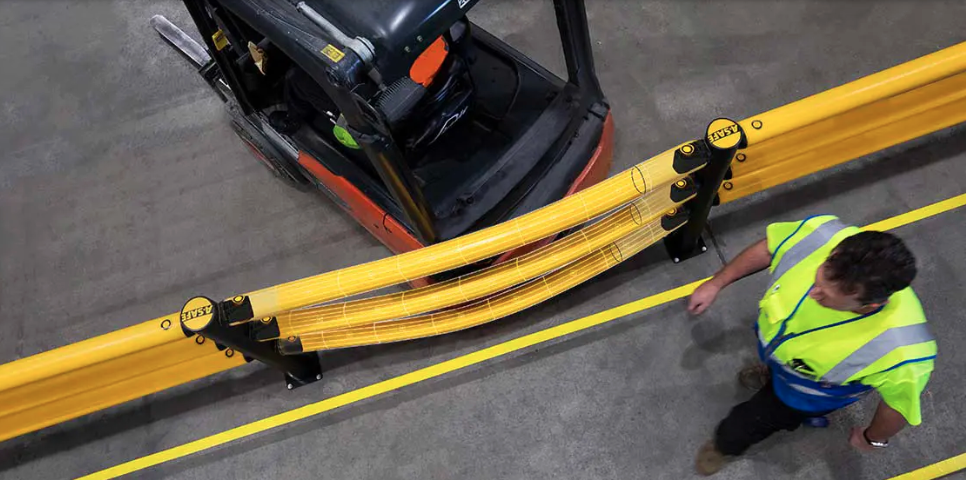
The system flexes to manage impact energy rather than relying on rigid resistance alone.
Reducing transferred force helps limit unnecessary stress on anchors and surrounding concrete.
Engineered recovery reduces the need to treat every significant impact as a replacement event.
Modular system architecture allows individual components to be addressed instead of automatically replacing an entire run.
Direct Cost Comparison
Two systems can protect the same area while creating very different ownership costs after installation.
| Cost Driver | Traditional Steel | A-SAFE Polymer |
|---|---|---|
| Initial Purchase | Lower upfront cost | Higher initial investment |
| Repainting | Recurring maintenance requirement | No repainting required |
| Corrosion | Treatment or replacement may be required | Polymer does not rust |
| Post-Impact Replacement | Permanent deformation can require replacement | Designed to flex and recover |
| Floor And Anchor Repair | Rigid force transfer can increase exposure | Energy absorption reduces force transfer |
| Downtime | Repair and replacement can restrict operations | Reduced replacement requirement can limit disruption |
| Replacement Scope | Damaged sections may require broader replacement | Modular components can be replaced individually |
Five-Year Cost Comparison
A-SAFE's modeled comparison starts with a higher initial purchase price, then shows how recurring repair and maintenance costs can change the financial picture over time.
Initial Purchase
Month 18
Year 2
Year 3
Year 4
Year 5
Illustrative modeled scenario based on A-SAFE proprietary data collected across global facilities. Actual costs, savings and payback vary by facility, installation, impact frequency and operating conditions.
What Drives The Return
The financial return is not created by one single saving. It comes from reducing the recurring repair, maintenance and disruption that follow repeated impacts.
Painting, corrosion treatment and ongoing remediation continue adding labor and material cost.
Integrated color and corrosion-resistant polymer remove recurring repaint and rust-treatment cycles.
A permanently deformed barrier creates another procurement and installation event.
Impact recovery is designed to reduce how often protection must be replaced after a strike.
Transferred force can expand the repair into concrete, anchors, vehicles and protected assets.
Energy absorption helps limit the costs created beyond the barrier itself.
Repair activity can close areas, redirect traffic and interrupt normal operations.
Reducing repair events helps keep facilities operating instead of repeatedly recovering from impact damage.
The Proof Behind The Payback
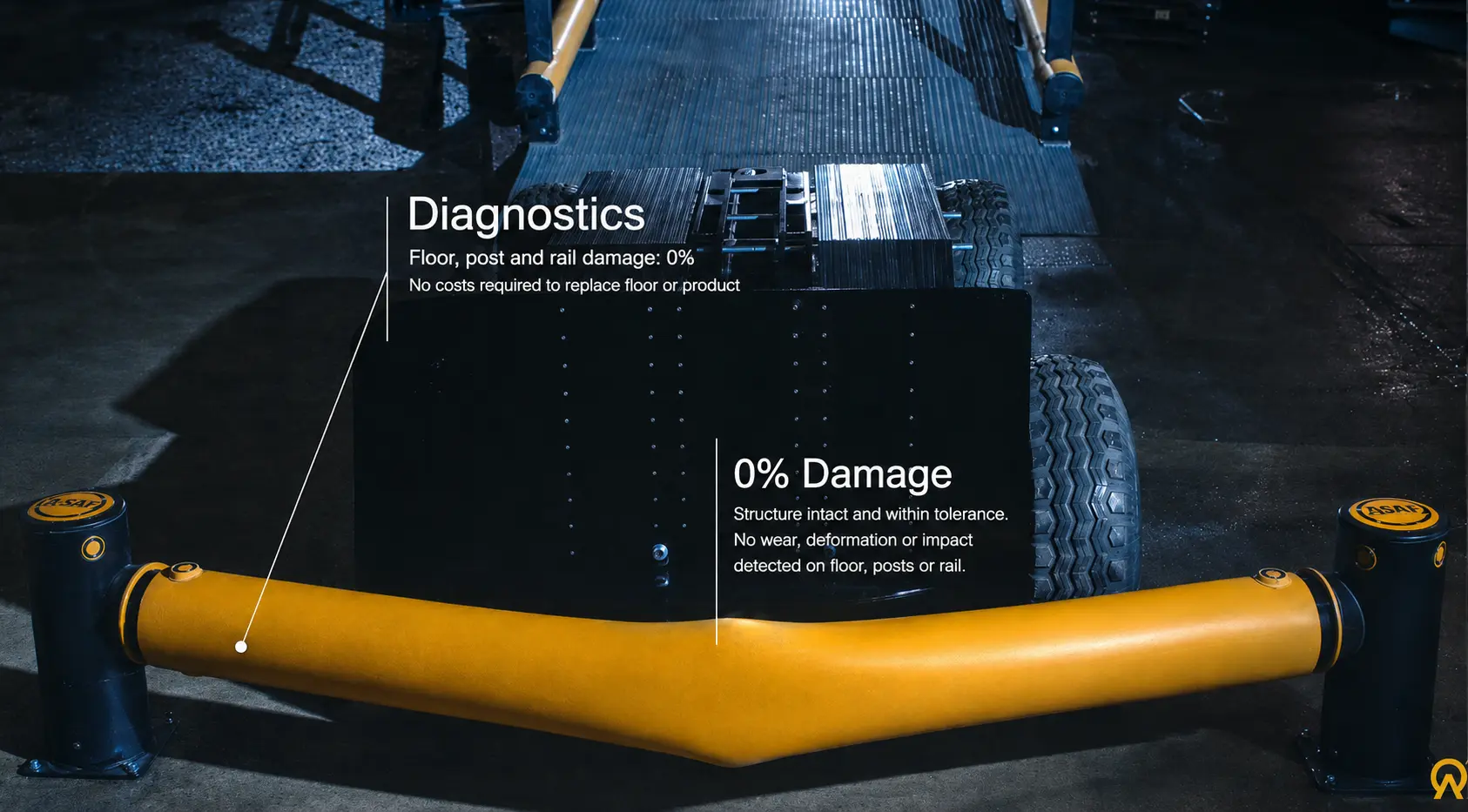
The financial case only works if the protection performs. A-SAFE engineers the material, components and complete system around controlled impact behavior and predictable performance.
Designed around controlled flex, energy absorption and structural recovery.
Impact testing helps establish how systems behave under defined forces and operating conditions.
Rails, posts, couplings, bases and fixings are designed to work together as one protective system.
Measured In A Working Facility
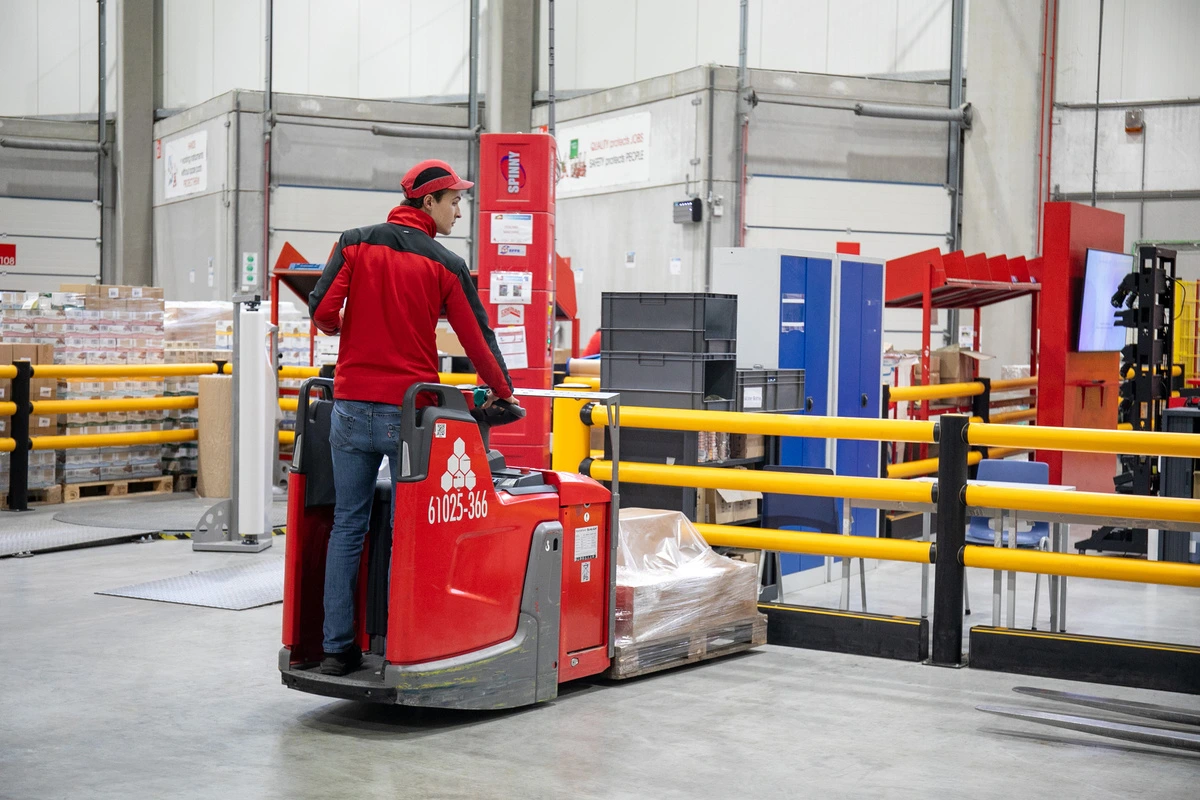
Katoen Natie evaluates return on investment for its capital safety projects. After implementing A-SAFE across its warehouse operation, the company reported that lower maintenance and repair costs, together with reduced sequential damage, changed the long-term financial case.
“The return on investment is between one and two years.” Dimitri Raman, Operational Director, Katoen Natie
Calculate What Matters
Every facility has a different cost of impact. Repair history, maintenance labor, downtime, floor damage and the assets being protected all shape the potential return.
Tell us about your facility and current impact-protection challenges. An A-SAFE specialist can help you understand the repair, maintenance, downtime, and long-term ownership costs affecting your operation.