
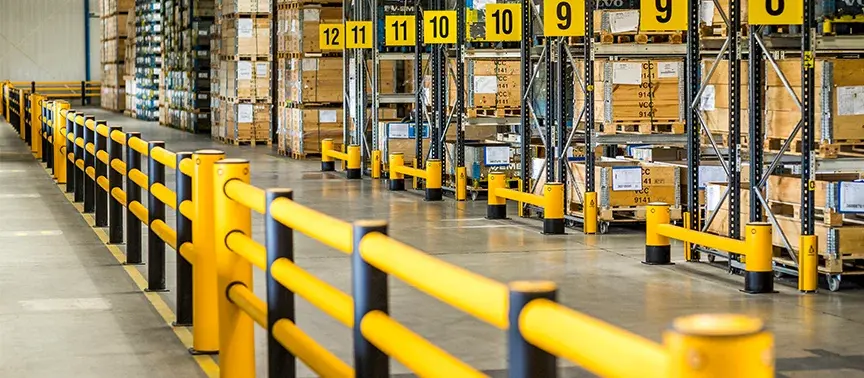
Yellow safety barriers are ubiquitous across airports and workplaces all over the world. They designate a safe path from A to B, keeping people segregated from traffic and reducing the risk of vehicle collision. But scratch the surface, and a yellow barrier by any other name isn’t always the same.
Quality can be quantified. It’s measured by how well a barrier performs, how well it regains its form after impact and how long it can be trusted to do the job it was installed to do. Quality aspects may not always be visible, but the effects of quality are palpable when it matters.
Is compliance enough?
International standards offer a degree of reassurance to safety officers. But because there is surprisingly little regulation when it comes to safety rails, purchasers can find themselves in somewhat of a grey area when it comes to selecting the right yellow barrier. While other safety systems - such as machine guarding – have to comply with ISO Standards, there is no such compliance to aim for when it comes to physical protection.
For a company committed to certification, it left a gap where compliance should be. A-SAFE safety systems are tested internally and externally to conform above and beyond legal standards and certifications. But when there is no legal requirement for the barriers literally designed to protect people, how can those installing the barriers protect themselves from inferior imitations?
How PAS 13 sets the benchmark
The gap in compliance led to the creation of PAS 13 – the international code of practice for industrial safety barriers. Created in 2017, PAS 13 set out to eliminate the guesswork surrounding adequate barrier protection. This 56-page document was published by the British Standards Institution (BSI), and has since been adopted by countries across Europe, the USA, Australia and New Zealand. PAS 13 is the only publicly available specification to help safety officers determine;
- The impact resistance your barriers need
- How much they will deflect under impact
- The pull-out force your fixings must withstand
Further advice helps you to select the correct height for your barrier, matching it to your likely impact points and the protection required from the ground up.
For a closer look at what PAS 13 covers, read our guide to safety barrier regulations. But essentially, A-SAFE’s extensive range of safety barriers and topple barriers aren’t just PAS 13-compliant – they were engineered by the company that co-wrote the document. Those at the helm of A-SAFE felt so strongly that business-owners should be able to choose a quality barrier with confidence that they set out to standardise barrier safety across the world. The result was PAS 13, drafted by A-SAFE - with the help of a steering group of leading blue-chip companies - and published by the BSI for adoption all over the world.
In the absence of an ISO standard, PAS 13 compliance is the best reassurance a purchasing officer can have when selecting a quality barrier engineered to perform.
A deeper dive into performance
Even when barriers are PAS 13 compliant, performance runs deeper still. A PAS 13-compliant yellow barrier is certified safe - it will perform as it should in the event of collision and absorb the impact of risk to protect people and assets.
Longevity meanwhile is another matter. Even barriers that look the same are engineered differently, and it’s the hidden construction which can offer a better return on investment over the lifespan of a product.
Developed and manufactured by A-SAFE polymer scientists, three-layer Memaplex™ polymer material is only found in A-SAFE products. Protected by a patent, Memaplex™ protects like no other barrier can, thanks to its;
- High-visibility, UV-protected outer layer
- Mid absorption zone that disperses kinetic energy
- Inner layer providing additional strength and flexibility
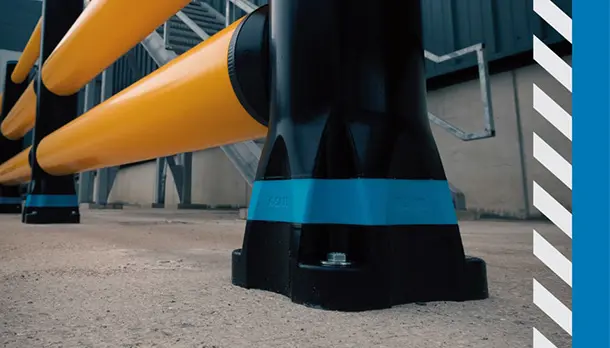
Barriers are strengthened further still with a patented, three-phase coupling system which slows and disperses impact energy, stopping kinetic forces from cracking concrete floors or damaging fixings. The coupling technology has a further appeal, allowing single barriers to be replaced in a modular approach for long-term flexibility and cost-efficiency.
Quality that pays for itself
It’s engineering that goes unnoticed under a bright, yellow façade. But when it comes to long-term performance, the truth is in the figures. Tests carried out on A-SAFE barriers indicated a return on investment within just 18 months. Over the course of its lifespan, the savings in replacement, downtime, repairs and disruption can be immeasurable.

Choosing the right Yellow Safety Barrier
The process of choosing a yellow barrier is never black and white. While cost is always a factor, purchasers have to factor in compliance, performance and longevity to protect their people future-proof their business.
Polymer barriers are your best defence against collision and the associated damage.
PAS 13 compliant barriers are your best defence against health and safety breaches and liability claims.
Innovative, patented engineering is your best defence against the false economy of barriers with an inferior capacity to perform.
Want to know more? Book a free site visit today.
Our safety experts can assess your site, identify the risks and recommend PAS 13-tested protection that fits your operations. Fill in the form to book your free site survey.